
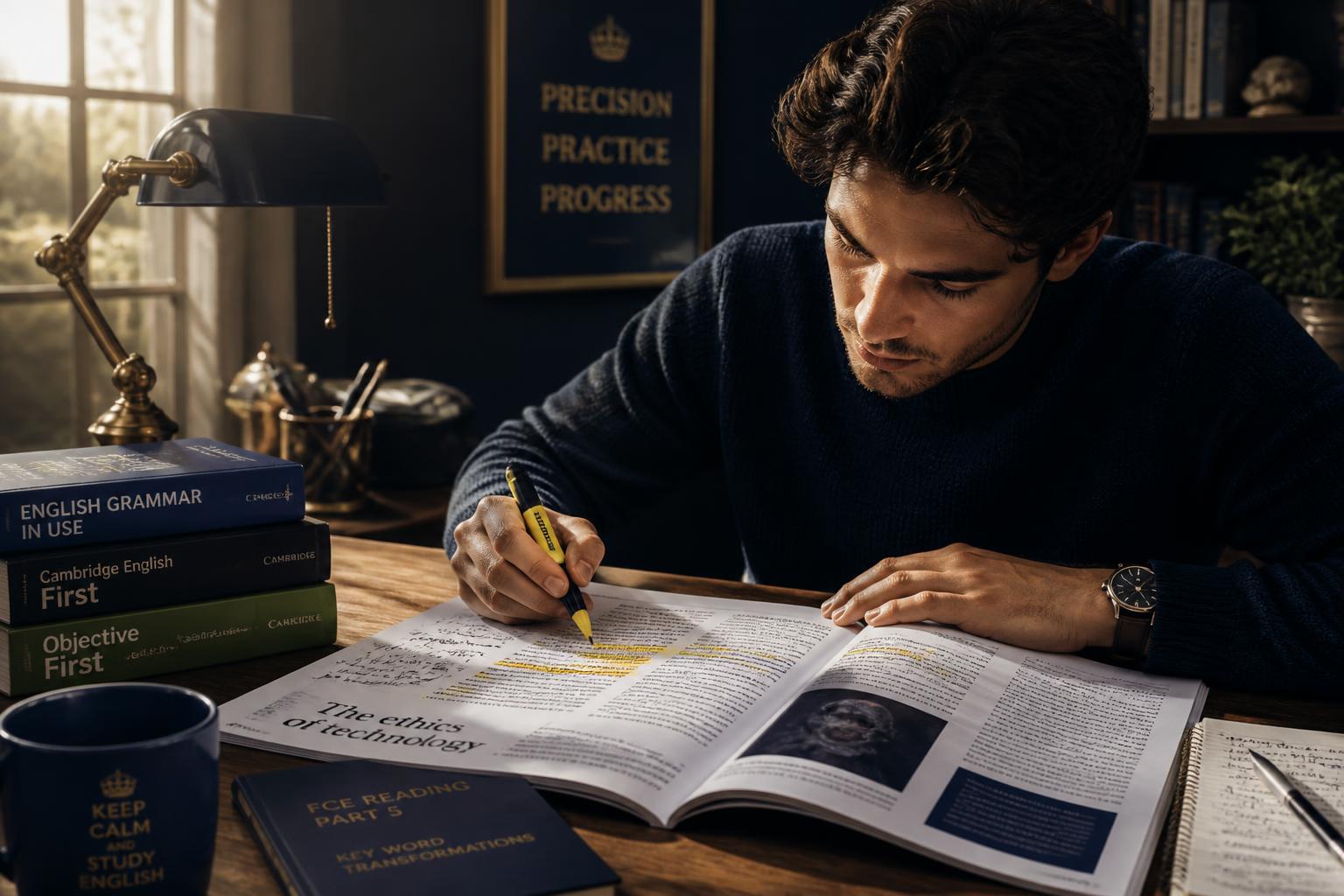
Module 3 · Reading & The Article · Lesson 09
Reading Part 5
One long text. Six questions. Four options each. Train to read for what the writer means — not just what the words say.
Get talking · Section 1
5 minRead this: 'Mark glanced at his watch for the third time and shifted in his seat.' What's Mark feeling? How do you know? — that single skill IS Reading Part 5.
In pairs, share a moment this week when someone showed an opinion WITHOUT stating it. What gave it away — word choice, tone, what they didn't say?
Look at any short news headline on your phone. Decide: is the writer NEUTRAL, POSITIVE or CRITICAL? Point to one word that proves it.
Grammar focus · Section 2
8–10 minReading the writer's mind — the 3 question families
Reading Part 5 always mixes three question types. INFERENCE — what the writer implies but never says directly. ATTITUDE/OPINION — how the writer or a character feels. REFERENCE — what a pronoun, 'this' or 'such' points back to in the text. Name the family first, then hunt for evidence.
Examples
→ INFERENCE: 'What does the writer suggest about…?' → Answer is NOT in the text word-for-word. Find the line that PROVES it.
→ ATTITUDE: 'How does the writer feel about…?' → Hunt for evaluative adjectives, adverbs and modal verbs ('sadly', 'inevitably', 'might have').
→ REFERENCE: 'What does THIS in line 14 refer to?' → Read the sentence BEFORE the pronoun. The answer is almost always there.
→ DETAIL/PARAPHRASE: same idea, different words. The wrong options usually REPEAT the text exactly — that's the trap.
→ VOCAB IN CONTEXT: 'What does X mean in line 22?' → Pick the meaning that fits the SURROUNDING sentence, not the dictionary first definition.
Question 1.An INFERENCE question asks you to find an idea that is…
Question 2.If the wrong option REPEATS the text word-for-word, it is probably…
Question 3.Best place to look for the answer to a REFERENCE question:
Question 4.Best clue to a writer's ATTITUDE:
Question 5.How many questions are there in FCE Reading Part 5?
Quick check 1.Roughly how many minutes should you spend on Part 5?
Quick check 2.If two options seem possible, you should…
Vocabulary · Section 3
5–7 minWords & phrases to own
to imply
to suggest without saying directly: 'The writer IMPLIES that he regrets the decision.'
Say one true sentence about your own life using "to imply".
to infer
what the READER does — work out the implied meaning: 'We can INFER from line 6 that…'
Say one true sentence about your own life using "to infer".
to hint at
to suggest indirectly: 'She HINTS AT a difficult childhood without describing it.'
Say one true sentence about your own life using "to hint at".
attitude
the writer's stance — positive, negative, neutral, sceptical, admiring.
Finish this out loud: "For me, attitude is …" — then give one reason.
tone
the feeling of the writing — ironic, warm, critical, detached.
Finish this out loud: "For me, tone is …" — then give one reason.
to evaluate
to judge — Reading P5 often asks how the writer evaluates something.
Say one true sentence about your own life using "to evaluate".
evidence
the WORDS in the text that prove your answer — always be able to point to them.
Finish this out loud: "For me, evidence is …" — then give one reason.
to paraphrase
to say the same idea in different words — what correct options do.
Say one true sentence about your own life using "to paraphrase".
distractor
a wrong option DESIGNED to look right — usually copies the text exactly.
Finish this out loud: "For me, distractor is …" — then give one reason.
reference
what a pronoun ('this', 'such', 'they') points back to earlier in the text.
Finish this out loud: "For me, reference is …" — then give one reason.
Tap an item on the left, then tap its match on the right.
Pronunciation · Section 4
3–4 minReading aloud for stress — the meaning is in the stressed words
Say it aloud
- • He '''reluctantly''' agreed — the agreement was unwilling. (negative attitude word: 'reluctantly')
- • She is '''undeniably''' talented — the writer admires her. (positive: 'undeniably')
- • Critics '''dismiss''' the idea — disapproval. ('dismiss' = critical)
- • The plan, '''sadly''', failed — the writer regrets it. ('sadly' = writer's feeling)
- • Drill: read paragraph 2 of today's text aloud. Underline every adjective/adverb you naturally stressed.
Reading · Section 5
8–10 minWhy Reading Part 5 is really a writing test
Read the passageTap to openTap to hide
Most candidates walk into the FCE exam expecting Part 5 of the Reading and Use of English paper to be a reading test. It is not, or at least not in the way they think. The text in front of them is rarely the obstacle — by B2 level, the vocabulary is largely within reach and the syntax is unremarkable. What trips candidates up, again and again, is the gap between what the writer says and what the writer means, and that gap is best understood as a problem of writing, not of reading.
Consider how the wrong options are constructed. The four choices that follow each question are not chosen at random; they are written, carefully, by item designers whose job is to model exactly the misreadings that B2 candidates routinely make. The most common distractor type takes a sentence from the text and lifts it word-for-word into an option, changing nothing. To a candidate skim-reading under time pressure, that exact match feels like proof, and the option is selected with a small sense of triumph. It is, of course, almost never the answer. The correct option is the one that has done the harder work — taking the writer's idea and recasting it in different words.
The second great trap is the reference question. The text refers to 'this approach', or to 'such a view', or simply to 'they', and the candidate is asked what these expressions point to. Faced with options that all look possible, candidates often pick the one closest to the pronoun, on the assumption that proximity equals meaning. It usually does not. Reference works backwards across whole paragraphs, and a fluent reader knows to scroll their eye up the text until the antecedent appears, not down to the next available noun.
Attitude questions, the third family, defeat candidates for a different reason. By their late teens most B2 learners can read a description and grasp its surface; what they have not yet been trained to do is read for evaluation. The writer's stance is almost never announced — 'I think this is a bad idea' — but is instead carried in adverbs ('inevitably', 'sadly', 'curiously'), in evaluative adjectives ('flawed', 'admirable', 'naive') and, especially, in modal verbs that hedge or commit ('might have worked', 'was bound to fail'). Candidates who skim past these tiny words and read only the nouns and main verbs will be left guessing.
The practical implication is simple and slightly counter-intuitive. To improve at Part 5, the best exercise is not to read more, but to read less — to slow down on the small evaluative words, to underline pronouns and trace their antecedents, and to ask, after every paragraph, 'What is the writer's attitude here, and which exact word tells me?' Done routinely, this is the habit that turns a Grade C reader into a Grade A one, and it transfers, perhaps unsurprisingly, into stronger essay writing too — because to read attitude is, in the end, to learn how it is built.
For questions 1–6, choose the answer (A, B, C or D) which you think fits best according to the text.
1Why does the writer say Part 5 is not really 'a reading test'?
2According to paragraph 2, an option that copies the text word-for-word is usually…
3Where does the writer say candidates should look to answer a REFERENCE question?
4What does the writer suggest about attitude in academic texts?
5The writer's overall attitude towards slow reading is…
6'It is, of course, almost never the answer' (paragraph 2). What does 'it' refer to?
Sentences have been removed from the text. Choose from the sentences A–E the one which fits each gap (1–4). There is one extra sentence which you do not need to use.
Exam conditions: keep “Read the passage” closed while you do this task.
1.What does the writer suggest about how open-plan offices were originally promoted?
2.What does the writer imply by mentioning 'lawyers, software architects, translators' in paragraph 1?
3.In paragraph 2, what was the surprising finding of the most-cited study?
4.What does 'this is the explanation that survived longest' (paragraph 3) refer to?
5.What attitude does the writer take towards companies now reinstating walls?
6.Which statement best summarises the writer's overall argument?
Listening · Section 6
8–10 minA Cambridge examiner coaches a small group on Reading Part 5 (≈ 2:00)
Listening audio
Tap play to listen. Drag the timeline to jump anywhere.
Show transcript
Examiner (Dr Khan):Right — before we mark these, I want to know how you APPROACHED the paper. Lucia, take me through question 23.
Lucia:Honestly, I picked option B because it used almost the exact words from line 14. It felt safe.
Examiner (Dr Khan):That's the trap, I'm afraid. We write that option precisely because it feels safe. The correct answer, A, was a paraphrase — same idea, different words.
Whenever you see an option that mirrors the text word for word, treat it as suspicious, not as proof.
Marco:What about question 25 — the one with 'this approach'? I picked the noun in the sentence before, because it was right next to it.
Examiner (Dr Khan):Proximity is a misleading guide. Pronouns like 'this' and 'such' often reach back over an entire paragraph. You should have been looking at the OPENING sentence of paragraph 3, not the closing sentence of paragraph 4.
Aisha:I find the attitude questions hardest. The writer rarely says 'I think X is bad'.
Examiner (Dr Khan):Exactly — and that's why you have to read the small words. Underline every adverb. 'Sadly', 'inevitably', 'curiously', 'predictably' — these tiny words carry the writer's feelings.
Underline them on first read and the attitude question almost answers itself.
Lucia:So the strategy is: paraphrase, not match. Backwards, not closest. Small words for attitude.
Examiner (Dr Khan):That's a perfect summary. Drill those three habits and you will gain three or four marks on Part 5 alone.
Question 1.Why was Lucia's answer to Q23 wrong?
Question 2.What is the examiner's advice on REFERENCE questions?
Question 3.Which small words does the examiner say carry the writer's attitude?
Question 4.Lucia's 3-rule summary is…
Exam skills · Section 7
5 minReading Part 5 — inference, attitude and reference
🎯 Reading Part 5
One text. Six questions. Choose A / B / C / D.
- Name the question type first (inference / attitude / reference)
- Underline the evidence line BEFORE choosing
- Distrust options that copy the text word-for-word
- For 'this / such / they' — read backwards, not forwards
Open the Exam Practice block below.
Quick Tip
Always underline the line in the text that PROVES your answer before you tick the option.
Exam Hack
Two options left? Pick the one that paraphrases the text — the one that repeats it is the trap.
Common Mistake
Candidates pick the closest noun for reference questions. Wrong — references reach BACKWARDS, often over a whole paragraph.
Your task
Spend 15–18 minutes on Part 5. Read the text once for gist (2 min), then attack each question with the 3-step routine: name → underline → paraphrase-check.
Example
Q: 'What does the writer suggest about candidates who pick exact-match options?' (INFERENCE) — text says 'the option is selected with a small sense of triumph. It is, of course, almost never the answer.' → Evidence underlined. Correct paraphrase: 'They feel confident but are usually wrong.' Distractor: 'They have read the text carefully' (lifts language but reverses meaning).
Practice · Section 8
8–10 minFill in the blank
Word bank — no clues, retrieve it
Question 1.The writer ___ that the candidate is unprepared, but never says so directly.
Question 2.From line 6 we can ___ that she regrets her decision.
Question 3.An option that copies the text word for word is usually a ___.
Question 4.Reference words like 'this' often point ___ across the previous paragraph.
Question 5.Evaluative adverbs such as 'sadly' or 'inevitably' carry the writer's ___.
Question 6.Always underline the ___ in the text before choosing your answer.
Q1.Verb (writer does it): 'The writer ___ that…'
Q2.Verb (reader does it): 'We can ___ from paragraph 2 that…'
Q3.Noun for a wrong option designed to look right (one word):
Writing · Section 9
5 minPut it in writing
Your task
Write 80 words explaining the writer's ATTITUDE in today's reading passage. Quote two small words ('sadly', 'inevitably', 'almost never'…) as your evidence.
Show model answer
The writer is strongly supportive of slow, deliberate reading. The attitude is carried in tiny evaluative words rather than direct statements. The phrase 'It is, of course, almost never the answer' uses 'almost never' to dismiss the exact-match strategy with near-certainty, while 'slightly counter-intuitive' shows the writer expects pushback and gently insists anyway. The closing claim — that the habit 'turns a Grade C reader into a Grade A one' — leaves no doubt: the writer views the slow-reading approach not as one option among many, but as the decisive one.
Speaking · Section 10
10–15 minMake it a real conversation
Roleplay
Pair drill. A reads a paragraph of the Exam Practice text aloud and stops at any underlined attitude word. B says, in one sentence, what that word tells us about the writer. Swap after every paragraph.
Useful phrases
- • The writer implies that…
- • We can infer from the phrase '…' that…
- • The use of 'sadly' / 'inevitably' shows that the writer feels…
- • 'This' refers back to… in the previous paragraph.
- • The distractor here lifts the text word-for-word, so I'd rule it out.
- • The correct option paraphrases the idea as…
Teacher notes
Optional · Teacher-led
Teacher Activities
Two short extensions tied directly to the Part 5 habits trained in the lesson. Both work 1:1 online and scale to small groups. ~18 min total
Homework · Section 11
Take-homeTake it home
Reading Part 5 — second long text
Read the article and answer six 4-option questions.
Time yourself18 minutes maximum. Use the 3-step routine — NAME the question family, UNDERLINE the evidence, PARAPHRASE-CHECK before ticking.
Why we still buy paperbacks
Twenty years ago, every commentator worth their byline predicted that the printed book would, by now, be a museum piece. The e-reader, they argued, was lighter, cheaper, infinitely searchable and — perhaps most importantly — invisible: nobody on a train could see what you were reading and judge you for it. The paperback, by contrast, was bulky, single-purpose and prone to coffee. The case looked closed.
It was not. Sales of e-readers peaked around 2014 and have softened almost every year since. Print, sluggish for a decade, has crept back. Publishers who quietly assumed they were in managed decline are now reissuing trade paperbacks in numbers nobody had budgeted for. The death notice, in short, was filed early.
The usual explanations — that print is 'nicer' to hold, that screens give us a headache — are partly true and almost entirely beside the point. Readers in surveys talk less about feel and more about ATTENTION. A paperback does only one thing. It does not buzz with notifications, it does not invite a quick scroll to social media, it does not offer the next four books in a series for one click. In an age of infinite distraction, single-purpose objects have, perhaps unexpectedly, become precious again.
There is a second effect, less often discussed but possibly more decisive: visibility. The paperback announces itself. A reader on the bus is, openly, a person who reads — to themselves, to anyone who notices, and to the strangers who occasionally start a conversation about the cover. The e-reader, designed to disappear, took that small public identity with it. For a generation raised online and presented constantly, a paperback turns out to be a quiet act of self-portrait.
None of this means the e-reader is finished; it remains the natural choice for travel, for the visually impaired, and for readers whose appetite outpaces their shelves. But the assumption that the paper book was a transitional technology, doomed by something better, looks, in hindsight, like the assumption itself was transitional. People are more contrary than the forecasts allowed.
Questions
- What does the writer suggest about the early predictions for printed books?
- According to paragraph 3, what do readers in surveys actually value most about paperbacks?
- What does 'It' in 'It does not buzz with notifications' refer to?
- What attitude does the writer take towards the e-reader's decline?
- What does the writer imply about people who read paperbacks in public?
- The overall tone of the final paragraph is best described as…
Attitude-adverb radar
Find ten attitude adverbs in any short opinion piece (BBC, Guardian, blog).
Highlight any adverb that signals the writer's feelings. For each one, write: word + (positive / negative / neutral) + one-sentence paraphrase of the attitude it carries.
- inevitably
- sadly
- curiously
- predictably
- remarkably
- unsurprisingly
- tellingly
- regrettably
- happily
- supposedly
100-word attitude paragraph
Pick any short opinion article. Write 100 words describing the writer's attitude.
Open with the writer's overall stance (supportive / sceptical / dismissive / balanced). Then give TWO short quotations from the article as evidence — at least one must be a small word (adverb or modal). Close with a one-sentence judgement: 'This stance is convincing / unconvincing because…'.
Recap · Section 12
2–3 minWhat you've learned
- Reading Part 5 = one long text + six 4-option questions, ≈ 15–18 minutes.
- Three question families dominate: inference, attitude/opinion, reference.
- Name the family → underline the evidence → choose the PARAPHRASE.
- Distrust options that copy the text word-for-word — they are designed to look right.
- Reference (this / such / they) almost always points BACKWARDS, often over a paragraph.
- Attitude lives in small evaluative words — adverbs, adjectives, modals. Underline them on first read.
Lesson progress
This lesson completes automatically once you finish every activity, or when you continue to the next lesson.