

Module 9 · Speaking & Fluency · Lesson 35
Negotiate & Decide
You already know the four moves. Now sharpen them: agree with real content (not just 'yes'), push back without sounding cold, and steer the final minute toward an actual shared decision instead of a stalemate or a surrender.
Get talking · Section 1
5 minThink of a time you agreed with someone but only said 'yeah, me too'. What could you have added to make the agreement sound like a real contribution, not just a nod?
Recall a group decision where you privately disagreed but stayed quiet to avoid conflict. Discuss: what's the cost of that in a Speaking Part 3 exam?
Practise saying this aloud: 'I can see arguments on both sides, but if I had to choose...' Notice how it moves a stuck discussion forward.
Grammar focus · Section 2
8–10 minBeyond yes/no — content agreement, principled pushback, and steering to a decision
Basic Part 3 answers just say 'I agree' or 'no, I don't think so'. Strong candidates agree WITH REASONS, disagree WITHOUT sounding rude, and actively steer the last minute toward a real decision rather than letting the clock run out.
Examples
→ Content agreement: 'Absolutely — and I'd add that it's especially true for younger students who don't have much free time.'
→ Principled pushback: 'That's a fair point about cost, but I still think safety has to come first, even if it's more expensive.'
→ Signposting the decision window: 'We've covered most of these now — shall we start narrowing it down?'
→ Steering to a compromise: 'We don't fully agree, but could we say both matter, just in different situations?'
→ Closing cleanly: 'So, final answer: we'd both go with the walking groups and the fitness app. Shall we leave it there?'
Question 1.What's wrong with a bare 'I agree' in Part 3?
Question 2.What does 'principled pushback' involve?
Question 3.Roughly when does the 'decision window' open?
Question 4.What happens if neither candidate signposts the decision?
Question 5.A good compromise phrase is...
Quick check 1.Is it acceptable to still disagree right up to the final decision?
Quick check 2.If your partner never signals moving to a decision, what should you do?
Quick check 3.Which is stronger content agreement?
Vocabulary · Section 3
5–7 minWords & phrases to own
to concede
to admit a point is valid, often before disagreeing.
"I'll concede that it's cheaper, but I still prefer the other option."
Concede one point in a disagreement you're currently having with someone.
principled
based on clear reasons or values, not stubbornness.
"Her objection was principled, not just contrary."
Describe a principled objection you've made recently.
to signpost
to signal clearly what stage of a conversation you're moving to.
"Let me signpost — I think we're ready to decide now."
Practise a signposting phrase for moving to a decision.
stalemate
a situation where neither side can move forward.
"The discussion reached a stalemate with 30 seconds left."
Describe a stalemate you've experienced in a group decision.
compromise
an agreement where each side accepts less than they wanted.
"They reached a compromise that satisfied both of them."
Suggest a compromise between two options you disagree about.
to narrow down
to reduce a wide range of options to fewer choices.
"Let's narrow it down to the two strongest options."
Narrow down a list of five things to two, aloud.
to steer (a conversation)
to actively guide a discussion toward a goal.
"She steered the conversation toward a decision cleanly."
Practise steering a conversation using 'so, given that...'.
fair point
an acknowledgement that someone's argument has merit.
"That's a fair point, but I'd still lean the other way."
Say 'that's a fair point' in response to an opinion you don't fully share.
to lean toward
to slightly favour one option over another.
"I lean toward the cheaper option, personally."
Say which of two options you lean toward and why.
final answer
the decision a pair commits to at the end of Part 3.
"So, final answer: we'll go with the walking groups."
Give a 'final answer' phrase for any recent decision.
Activate · use it within minutes
Pick any opinion you disagree with. Concede one point, then push back, using the target phrases.
I'll concede that...
but I still think...
that's a fair point, however...
Tick each word as you use it
Complete each signposting sentence naturally.
Given everything we've said, shall we ___
We're running low on time, so let's ___
So, final answer, I think we should ___
Tick each word as you use it
Tap an item on the left, then tap its match on the right.
Pronunciation · Section 4
3–4 minSoftening stress for pushback, firming stress for the final decision
Say it aloud
- • Gentle concession: 'That's a FAIR point...' — even, unhurried stress, no sharp peaks.
- • Softened but clear pushback: '...but I still think SAFEty matters more.' — clear but not aggressive stress on the key word.
- • Firm decision close: 'So, FINAL answer: we'll go with the WALKing groups.' — confident falling stress on 'final' and the decision noun.
- • Avoid a rising, uncertain tone on the final decision — it can sound like you're still asking, not deciding.
- • Practise the shift: soft-stress concession → firm-stress decision, back to back, in one sentence.
Reading · Section 5
8–10 minThe minute that decides your Part 3 score
Read the passageTap to openTap to hide
Cambridge examiners assessing Speaking Part 3 are trained to watch one moment more closely than any other: the transition from discussion to decision. Many candidates handle the first two minutes competently — they invite each other in, they react, they build — but then the final minute arrives and something goes wrong. Either nobody moves the conversation forward, and the clock runs out mid-discussion, or one candidate suddenly announces a decision alone, cutting their partner out entirely.
Both failures are avoidable with the same skill: signposting. A candidate who says, clearly and audibly, 'We've covered most of the options now — shall we start narrowing it down?' does something that costs almost no extra vocabulary but earns real credit under Interactive Communication. It shows awareness of the task's structure and actively invites the partner into the final phase, rather than assuming they'll notice the time is nearly up.
The second half of this skill is handling disagreement gracefully during the decision itself. Examiners do not expect or require identical opinions. What they reward is candidates who can concede a partner's point ('You're right that cost matters') before offering their own view ('but I still think the safety angle is more important'), and who can ultimately either agree, or agree to disagree in a structured way ('We see it differently, but if we had to pick one, I'd lean toward...'). This is a strictly different skill from simply having an opinion — it is the skill of negotiating one, live, with another person listening.
Weaker candidates often fall into one of two traps in this final phase. The first is capitulation: agreeing instantly with whatever the partner says just to avoid conflict, producing a decision with no real content behind it. The second is stalemate: repeating the same disagreement without ever attempting a compromise or a graceful concession, so the discussion simply stops when time runs out. Strong candidates avoid both by treating the decision phase as a mini-negotiation with its own moves — concede, contribute, signpost, close — rather than as an afterthought tacked onto free discussion.
For questions 1–5, choose the answer (A, B, C or D) which you think fits best according to the text.
1Which moment do examiners watch especially closely, according to the passage?
2What does signposting cost, and what does it earn?
3Do examiners require identical opinions in the decision phase?
4What is 'capitulation', as described in the passage?
5What is 'stalemate', as described in the passage?
Sentences have been removed from the text. Choose from the sentences A–E the one which fits each gap (1–4). There is one extra sentence which you do not need to use.
Exam conditions: keep “Read the passage” closed while you do this task.
Listening · Section 6
8–10 minSample Speaking Part 3 — negotiating a school activity budget
Listening audio
Tap play to listen. Drag the timeline to jump anywhere.
Show transcript
Examiner:Talk to each other about how useful each of these ideas would be for encouraging students to be more active. Then decide which two would work best.
Sofia:Shall we start with the free sports clubs? I think that's probably the strongest one.
Daniel:I'd agree, actually, and I'd add that it works especially well for students who can't afford private clubs.
Sofia:Good point. What about the walking groups at lunchtime — do you think that's as strong?
Daniel:Honestly, I'm not sure. I think a fitness tracking app might motivate more students, since everyone has a phone.
Sofia:That's a fair point about the phones, but I still think walking groups build more of a habit, because they're social and scheduled.
Daniel:Fair enough — I hadn't thought about the social side. OK, we've covered most of these now — shall we start narrowing it down?
Sofia:Yes, let's. I'd say free sports clubs are definitely in.
Daniel:Agreed. And for the second one — walking groups or the app?
Sofia:We don't fully agree, but could we say both matter, just for different students?
Daniel:That works. So, final answer: free sports clubs and walking groups, with the app as a nice extra.
Sofia:Agreed. Let's leave it there.
Question 1.How does Daniel respond after agreeing about the sports clubs?
Question 2.What does Sofia do before disagreeing about the walking groups?
Question 3.Who signposts the move to a decision?
Question 4.How do they resolve their disagreement about the second option?
Exam skills · Section 7
5 minSpeaking Part 3 — Negotiate and Decide
🎯 Speaking Part 3+
Discuss 5 options for ~2 min, then negotiate a real shared decision in ~1 min.
- Agree with CONTENT, not just 'yes'
- Concede a fair point before pushing back
- Signpost the decision window yourself if needed
- Close with a clear final answer, even if you compromise
Open the FCE Exam Practice prompt sheet below.
Quick Tip
Watch the clock — around the 2-minute mark, actively signpost the move to deciding.
Exam Hack
Keep one compromise phrase ready: 'We don't fully agree, but could we say both matter, just in different situations?' It rescues almost any stuck negotiation.
Common Mistake
Don't capitulate instantly to avoid conflict — an empty 'yes, OK, whatever you think' scores lower than a considered concession.
Your task
Pair task. Use the prompt sheet below: discuss for 2 minutes, then negotiate to a decision in 1 minute using content agreement, principled pushback, signposting and a clean close.
Example
Sofia: 'I'd agree, and I'd add it helps students who can't afford private clubs.' [content agreement] Daniel: 'That's fair, but I still think the app might reach more students.' [principled pushback] Sofia: 'We've covered most of these — shall we start narrowing it down?' [signpost] Daniel: 'So, final answer: sports clubs and walking groups.' [close]
Practice · Section 8
8–10 minFill in the blank
Word bank — no clues, retrieve it
Question 1.'That's a fair point, ___ I still think safety matters more.'
Question 2.'Shall we start ___ it down?' is a way to signpost the decision.
Question 3.Agreeing instantly to avoid conflict, with no real reasoning, is called ___.
Question 4.'So, ___ answer: we'll go with the walking groups.'
Question 5.A ___ is an agreement where each side accepts less than they originally wanted.
Q1.Give a phrase that concedes a point before disagreeing:
Q2.Give a phrase that signposts moving to a decision:
Q3.Give a phrase that offers a compromise:
Writing · Section 9
5 minPut it in writing
Your task
Write a full imagined Part 3 negotiation (about 150-180 words) between two candidates discussing five ways to reduce food waste at school. Include at least one content agreement, one principled pushback, one signposting phrase, and one clean close.
Show model answer
A: 'Shall we start with the composting bins? I think that's the strongest option.' B: 'I'd agree, and I'd add it also teaches students about the environment directly.' A: 'That's true. What about the smaller portion sizes idea?' B: 'Honestly, I think students would just take seconds, so it might not reduce waste much.' A: 'That's a fair point, but I still think it would help for younger students who over-order.' B: 'Fair enough. We've covered most of these now — shall we start narrowing it down?' A: 'Yes — I'd say composting is definitely in.' B: 'Agreed. And for the second, maybe the awareness posters, since they're cheap and easy?' A: 'We don't fully agree on how effective they are, but could we say they're a good low-cost extra?' B: 'That works. So, final answer: composting bins and awareness posters. Let's leave it there.'
Speaking · Section 10
10–15 minMake it a real conversation
Roleplay
1:1 online task. Teacher plays 'Candidate B' using the prompt sheet below (five ways to encourage activity at school). Student must use at least one content agreement, one principled pushback, one signposting phrase, and reach a final decision within 3 minutes total.
Useful phrases
- • Absolutely, and I'd add that...
- • That's a fair point, but I still think...
- • Shall we start narrowing it down?
- • We don't fully agree, but could we say...?
- • So, final answer, we'll go with...
- AI think free sports clubs are the strongest option.
- B_______________
- BI'd ___, and I'd add they help students who can't afford private clubs.
- AThat's a fair point, but I still think the app might reach more students.
- B_______________
- BWe've covered most of these now — shall we start ___ it down?
- ASo, final answer, we'll go with sports clubs and the app.
Teacher notes
Optional · Teacher-led
Teacher Activities
Two drills that build negotiation discipline for the decision phase. Both work 1:1 online. ~14 min total
FCE Exam Practice · Section 11
20–30 minReal FCE tasks
Cambridge B2 First · Speaking · Part 3 · Collaborative Task. The prompt sheet below mirrors the Cambridge booklet. Teacher Mode reveals examiner guidance, common errors, and a band-5 sample negotiation.
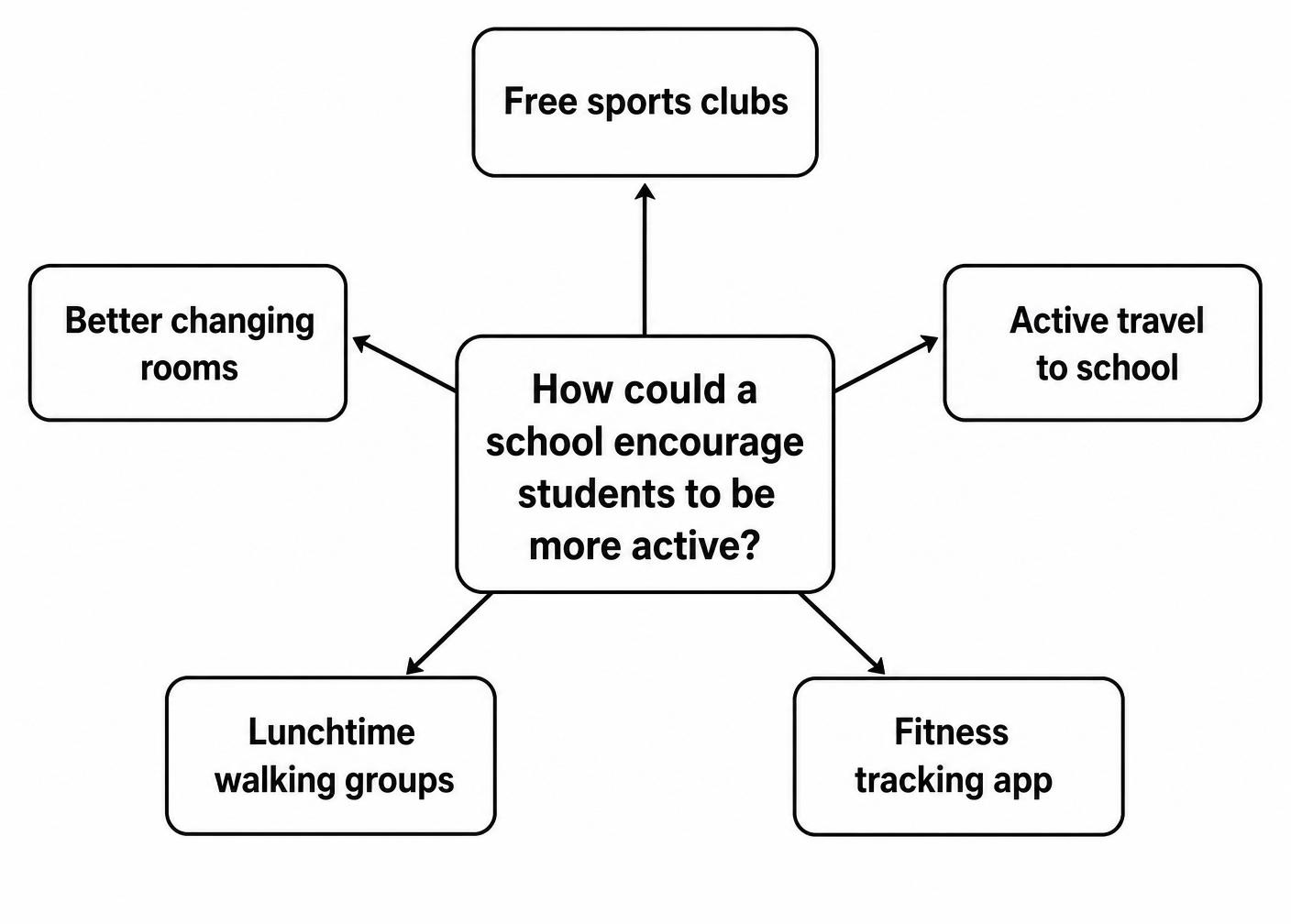
How could a school encourage students to be more active?
Decision question (after ~2 minutes)
"Now decide which TWO of these would be most effective for encouraging students to be more active."
- Absolutely, and I'd add that...
- I'd go further and say...
- Exactly — which is why...
- That's a fair point, but I still think...
- You're right about that, however...
- I see why you'd say that, but...
- Shall we start narrowing it down?
- We've covered most of these now — shall we decide?
- Given everything, maybe we should choose.
- So, final answer, we'll go with...
- We don't fully agree, but could we say...?
- Let's leave it there, then.
Homework · Section 12
Take-homeTake it home
Record a full negotiation
Record yourself playing BOTH sides of a Part 3 negotiation on a topic of your choice, using all four moves at least once each.
Use content agreement, principled pushback, signposting and a clean close. Listen back and tick off each move as you hear it.
- Topic idea 1: ways to reduce plastic waste at home
- Topic idea 2: ways to make public transport more popular
- Topic idea 3: ways to help new students settle into a school
Questions
- Did you concede a fair point at least once before disagreeing?
- Did you signpost the decision window clearly?
Negotiation phrase bank
Memorise 8 phrases: 2 for content agreement, 2 for principled pushback, 2 for signposting, 2 for closing.
Write each on a flashcard and drill until automatic in full sentences.
- Absolutely, and I'd add that...
- I'd go further and say...
- That's a fair point, but I still think...
- You're right about that, however...
- Shall we start narrowing it down?
- Given everything, maybe we should decide?
- So, final answer, we'll go with...
- Let's leave it there.
Write two more full negotiations
Write two full 150-180 word Part 3 negotiations on topics of your choice, tagging each of the four moves.
Choose any two five-option negotiation topics (e.g. 'ways to make a town more welcoming to tourists', 'ways to reduce screen time among teenagers'). Tag [AGREE] [PUSHBACK] [SIGNPOST] [CLOSE] clearly.
Recap · Section 13
2–3 minWhat you've learned
- Content agreement adds reasons, not just 'yes'.
- Principled pushback concedes a fair point before disagreeing.
- Someone must signpost the move from discussion to decision.
- Compromise phrases rescue stuck negotiations near the end.
- Close cleanly with a final answer, even if it's a compromise.
- Avoid both capitulation (empty instant agreement) and stalemate (no decision reached).
Lesson progress
This lesson completes automatically once you finish every activity, or when you continue to the next lesson.