

Module 4 · Collaboration, Gapped Text & Mock 1 · Lesson 13
Speaking Part 3
Two candidates. One prompt sheet. Five options. Two minutes of open discussion + one minute to reach a decision. Train the four moves examiners reward: invite, react, build, decide.
Get talking · Section 1
5 minThink of the last time you had to choose with someone — a restaurant, a film, a holiday. Who suggested first? Who finally decided? Did anyone say 'I don't mind'? (Examiners HATE 'I don't mind'.)
In Part 3 you get ~3 minutes total: about 2 minutes to discuss and 1 minute to decide. Discuss in pairs: which is harder for you — keeping a discussion going, or actually reaching agreement?
Translate into English: 'I see what you mean, but I'm not sure I agree.' Now soften it. Now sharpen it. Notice how tone changes meaning.
Grammar focus · Section 2
8–10 minThe four moves of Part 3 — invite · react · build · decide
Speaking Part 3 is not a debate; it's a collaboration. Examiners reward candidates who DO things to each other, not who simply give long opinions. The four moves are.
- 1INVITEbring your partner in ('What do you think about…?').
- 2REACTagree, disagree, or partly agree with what they just said.
- 3BUILDadd a new reason or example.
- 4DECIDEin the final minute, summarise and commit ('So, are we agreed that…?'). Strong candidates loop through all four moves naturally.
Examples
→ INVITE: 'What about you — do you think public transport really matters?'
→ REACT (agree+): 'Absolutely, and I'd go further — without good transport the city stops working.'
→ REACT (disagree polite): 'I see your point, but I'm not sure — I'd say green spaces matter more.'
→ BUILD: 'That's a good point. On top of that, think about how it affects families with young children.'
→ DECIDE: 'So, shall we say public transport and green spaces are the two strongest?' / 'I think we agree on green spaces, then.'
→ AVOID: long monologues, 'I don't know', 'I don't mind', or finishing your partner's sentence.
Question 1.How long is the full Speaking Part 3 task?
Question 2.What is the BIGGEST mistake in Part 3?
Question 3.Which is the strongest INVITE phrase?
Question 4.After 2 minutes of discussion, you have ~1 minute to…
Question 5.Is it OK to politely DISAGREE in Part 3?
Quick check 1.Must you discuss EVERY option on the prompt sheet?
Quick check 2.If you finish discussing before the examiner stops you, you should…
Quick check 3.Must you AGREE on a final decision in the second stage?
Vocabulary · Section 3
5–7 minWords & phrases to own
to negotiate
to talk through differences and reach an agreement — the heart of Part 3.
Say one true sentence about your own life using "to negotiate".
to invite (your partner in)
to deliberately ask for their view: 'What do you think?'
Say one true sentence about your own life using "to invite".
to react
to respond to what your partner just said — not ignore it.
Say one true sentence about your own life using "to react".
to build on (a point)
to extend an idea your partner started.
Say one true sentence about your own life using "to build on".
to push back (politely)
to disagree without being rude: 'I see your point, but…'
Say one true sentence about your own life using "to push back".
to summarise
to gather the main points of the discussion before deciding.
Say one true sentence about your own life using "to summarise".
to commit
to make and accept a final decision.
Say one true sentence about your own life using "to commit".
tentative
uncertain, hesitant — useful tone when softening disagreement.
Finish this out loud: "For me, tentative is …" — then give one reason.
concession
admitting your partner has a point before disagreeing: 'You're right that… but…'
Finish this out loud: "For me, concession is …" — then give one reason.
to dominate
to take over the conversation — Part 3's biggest sin.
Say one true sentence about your own life using "to dominate".
Tap an item on the left, then tap its match on the right.
Pronunciation · Section 4
3–4 minIntonation that signals collaboration, not lecture
Say it aloud
- • Rising invitation: 'What do YOU think? ↗' — voice rises on 'think'. Don't end flat.
- • Soft agreement: 'Absolutely — and I'd ADD that…' — stress falls on 'add', not 'absolutely'.
- • Concession with elongated vowel: 'Weeell… I see your point, but…' — buys time and signals you're thinking.
- • Question tag for invitation: 'It matters more, doesn't it? ↗' — turns a statement into an invitation.
- • Avoid robotic stress: 'I. AGREE. WITH. YOU.' — sounds defensive. Glide instead: 'I'd agree with that.'
Reading · Section 5
8–10 minWhy Speaking Part 3 is really a listening test
Read the passageTap to openTap to hide
Most candidates prepare for Speaking Part 3 the wrong way. They memorise opinions about every conceivable B2 First topic — happiness, work-life balance, technology, the environment — and then walk into the exam ready to deliver them. They are about to be marked down.
Part 3 is, in disguise, a listening test. The examiners are not interested in whether you have a unique opinion about whether public transport matters more than green spaces. They are interested in whether you HEARD what your partner just said, and whether you DID something with it. The Cambridge mark scheme for Interactive Communication is explicit: candidates score higher when they invite, react and build on contributions, and lower when they deliver pre-prepared opinions that ignore the other person.
A candidate who arrives with five memorised paragraphs and reads them aloud is, technically, speaking fluent English. But they are failing the task. The other candidate hears nothing addressed to them, has nothing to react to, and the pair becomes two solo performances that happen to share a table. Examiners notice immediately.
The practical move is simple. In the 15-second prompt-sheet preview, do NOT plan your opinions. Plan your QUESTIONS instead. 'What do you think about this one?' and 'Why do you say that?' are worth more than the perfectly phrased opinion you might have written in advance. Once the discussion starts, listen for one thing your partner says, and use it. 'That's a good point — and I'd add…' or 'I see what you mean, but actually…' demonstrates that the conversation is real.
In the final minute, you must decide. Polite disagreement is fine — examiners do not require agreement — but you must REACH a decision together, summarise it cleanly, and stop talking. Candidates who run out the clock arguing in circles lose marks for organisation; candidates who reach a quick clean decision with mutual respect score top of the band.
For questions 1–5, choose the answer (A, B, C or D) which you think fits best according to the text.
1According to the writer, Part 3 is really a test of…
2What does the writer say about candidates with memorised opinions?
3Best use of the 15-second prompt preview is to…
4Do examiners require you to AGREE in the decision phase?
5Candidates who run out the clock arguing in circles lose marks for…
Sentences have been removed from the text. Choose from the sentences A–E the one which fits each gap (1–4). There is one extra sentence which you do not need to use.
Exam conditions: keep “Read the passage” closed while you do this task.
Listening · Section 6
8–10 minSample Speaking Part 3 — two B2-band candidates discussing 'What makes a city a good place to live?'
Listening audio
Tap play to listen. Drag the timeline to jump anywhere.
Show transcript
Examiner:Now, I'd like you to talk about something together for about two minutes. Here are some ideas about what makes a city a good place to live. Talk to each other about how important each of these is.
You don't need to agree.
Maria:Shall we start with public transport? Where I'm from, if the buses don't run, the whole city stops. What do you think — is it the most important?
Tom:I'd say it's important, definitely, but I'm not sure it's THE most important. For me, green spaces matter more — even five minutes in a park completely changes my mood.
Maria:That's a good point, and actually I'd add that green spaces become essential when you can't afford to leave the city, like for people on lower incomes.
Tom:Exactly — which brings us to affordable housing. If you can't afford to live there, none of the other things matter, do they?
Maria:Hmm, I see your point, but I'd argue cities have always been expensive — what really matters is whether there are JOBS to pay for the rent.
Tom:Fair enough. So we'd both put job opportunities high then?
Maria:Yes — and cultural life? I think that's more of a bonus, not essential.
Tom:I'd agree on that. So, are we saying the strongest are job opportunities and green spaces?
Maria:I think so. Let's go with that.
Question 1.How does Maria OPEN the discussion?
Question 2.What does Tom do after disagreeing about transport?
Question 3.Which phrase shows POLITE disagreement?
Question 4.What is their final DECISION?
Exam skills · Section 7
5 minSpeaking Part 3 — Collaborative Task
🎯 Speaking Part 3
Discuss 5 options for ~2 min, then decide together in ~1 min.
- Open with an INVITE, not an opinion
- REACT to your partner before adding your own view
- BUILD on their points to keep the discussion alive
- DECIDE clearly in the final minute — even if you disagree
Open the FCE Exam Practice prompt sheet below.
Quick Tip
Use the 15-second preview to plan QUESTIONS for your partner, not opinions for yourself.
Exam Hack
Memorise ONE phrase per move (invite / react / build / decide). Four phrases is enough to look interactive throughout the task.
Common Mistake
Don't deliver memorised opinions in monologue form. Examiners can hear it instantly and your Interactive Communication mark drops.
Your task
Pair task. Use the prompt sheet below: discuss for 2 minutes, then reach a decision in 1 minute. Loop through INVITE → REACT → BUILD → DECIDE.
Example
Maria: 'Shall we start with public transport? What do you think — is it the most important?' [INVITE] Tom: 'I'd say important, but I'd put green spaces first.' [REACT] Maria: 'That's a good point, and I'd add green spaces matter more for people on lower incomes.' [BUILD] Tom: 'So shall we say job opportunities and green spaces are the strongest?' [DECIDE]
Practice · Section 8
8–10 minFill in the blank
Word bank — no clues, retrieve it
Question 1.Part 3 lasts about ___ minutes total.
Question 2.You should react to your partner with phrases like 'I see your ___, but…'
Question 3.After about 2 minutes you should transition to ___ a decision.
Question 4.A strong INVITE phrase is 'What do you ___ about this one?'
Question 5.Polite pushback often starts with 'I'm not so ___ about that.'
Question 6.To summarise: 'So, ___ we agreed that…?'
Q1.Complete the INVITE: 'What do you ___ about this one?'
Q2.Complete the polite pushback: 'I see your ___, but…'
Q3.Complete the decision: 'So, are we ___ that…?'
Writing · Section 9
5 minPut it in writing
Your task
Imagine your school is choosing ONE new facility to add: a library, a gym, a music room, a café, or a quiet study space. Write THREE short exchanges (3 lines each) modelling INVITE → REACT → BUILD.
Show model answer
EXCHANGE 1 (open) A: Shall we start with the library? Do you think it's the most useful? [INVITE] B: Honestly, I'd put the study space first — half the students don't have a quiet place at home. [REACT] A: That's a really good point, and on top of that exams are coming. [BUILD] EXCHANGE 2 (push back politely) B: What about a café — wouldn't that bring people together? [INVITE] A: I see your point, but I'm not sure it's a priority — we already have one nearby. [REACT — polite disagreement] B: True, but a school café would be cheaper and we'd hang out more. [BUILD] EXCHANGE 3 (decide) A: So, shall we say the study space and the music room are the strongest? [DECIDE] B: Yes — let's go with that.
Speaking · Section 10
10–15 minMake it a real conversation
Roleplay
1:1 online task. Teacher takes Candidate B (or use the prompt sheet alone with the student playing both roles, switching chairs). Run the full Part 3: 2 minutes open discussion + 1 minute decision. Use the central question 'What makes a city a good place to live?' and the five options on the prompt sheet.
Useful phrases
- • Shall we start with this one? / Where shall we begin?
- • What do you think about…?
- • I see your point, but I'd argue…
- • Absolutely — and I'd add that…
- • That's a really good point, isn't it?
- • Hmm, I'm in two minds about that.
- • So, are we agreed that…?
- • Let's go with that, then.
Teacher notes
Optional · Teacher-led
Teacher Activities
Two short drills that train the 'invite-react-build' loop. Both work 1:1 online. ~14 min total
FCE Exam Practice · Section 11
20–30 minReal FCE tasks
Cambridge B2 First · Speaking · Part 3. Two minutes open discussion + one minute decision. The prompt sheet below mirrors the Cambridge booklet. Teacher Mode reveals examiner guidance, common errors and a band-5 model exchange.
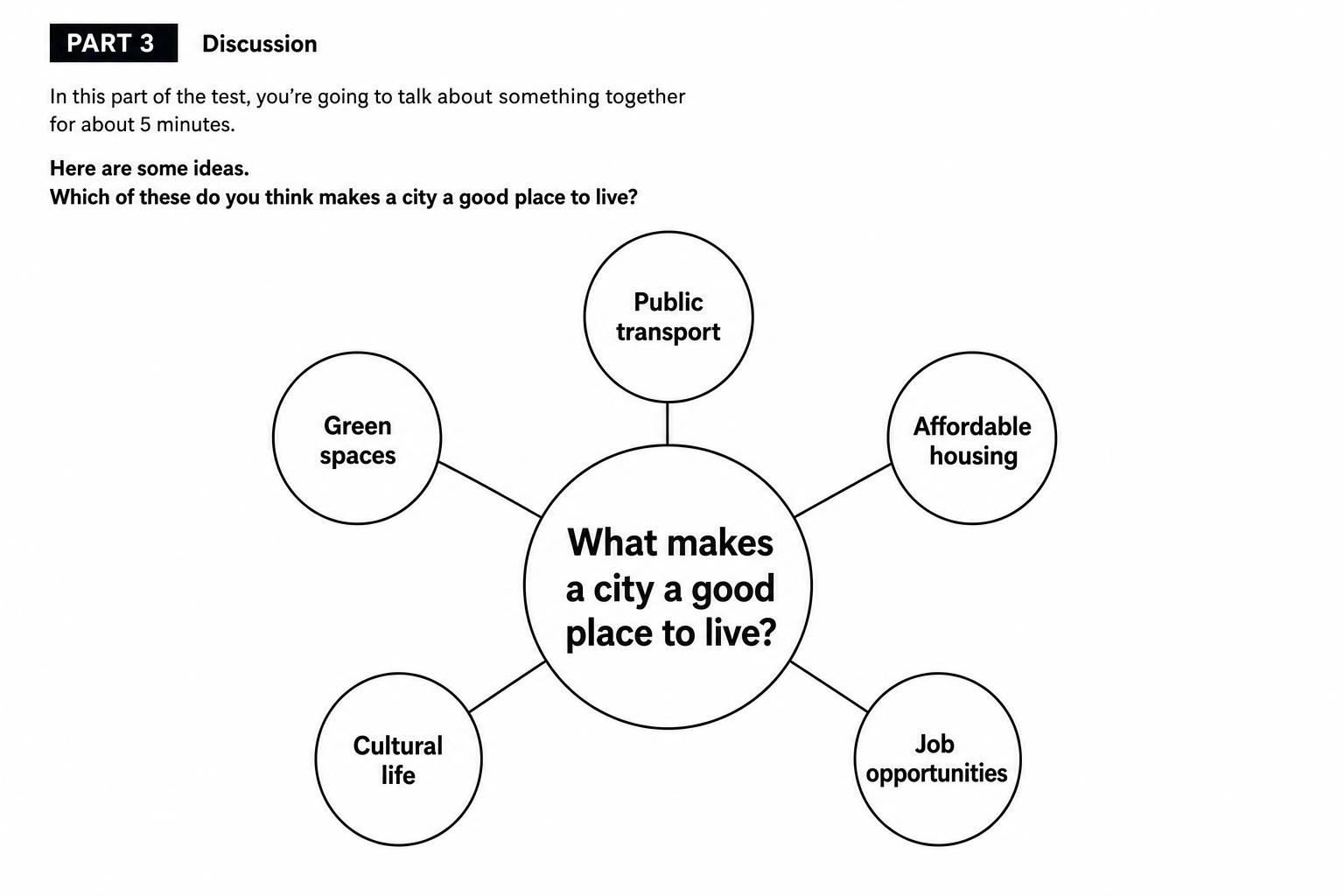
What makes a city a good place to live?
Decision question (after ~2 minutes)
"Now you have about a minute to decide together: which TWO of these make the biggest difference to whether a city is a good place to live?"
- Shall we start with this one?
- What do you think about…?
- Where would you begin?
- How about this option?
- Absolutely — and I'd add that…
- Exactly, which is why…
- That's a really good point.
- I couldn't agree more.
- I see your point, but…
- Hmm, I'm not so sure about that.
- I'd look at it slightly differently.
- That's true up to a point, however…
- On top of that,…
- For example,…
- Which brings us to…
- And that's not all — also…
- So, shall we say…?
- On balance, I'd go with…
- Let's go with that, then.
- So we agree on… and …, yes?
Homework · Section 12
Take-homeTake it home
Record a full 3-minute Part 3
Record yourself completing a Part 3 task — solo, playing both candidates.
Use the topic 'What's the best way for teenagers to relax?' with these options: video games, sport, music, friends, time alone. Speak for ~2 minutes, then DECIDE in ~1 minute. Listen back and count how many INVITES you used.
- video games
- sport
- music
- time with friends
- time alone
Questions
- How many INVITES did you give the imagined partner?
- Did you REACT before giving your own opinion?
- Did you reach a clean DECISION inside 3 minutes?
Phrase bank — 12 ready-made moves
Memorise 12 phrases — 3 per move (invite, react, build, decide).
Write each phrase on a flashcard. Drill until you can say each one without thinking. The point: in the exam, the brain only has time for content — the moves must be automatic.
- INVITE — What do you think about this one?
- INVITE — Where shall we start?
- INVITE — How about this option?
- REACT (agree) — Absolutely, and I'd add that…
- REACT (partly) — I see your point, but…
- REACT (disagree) — Hmm, I'm not so sure, actually.
- BUILD — That's a good point — for example,…
- BUILD — On top of that,…
- BUILD — Which is exactly why…
- DECIDE — So, shall we say…?
- DECIDE — On balance, I'd go with…
- DECIDE — Let's go with that, then.
Write a 6-exchange Part 3 dialogue
Write a model Part 3 dialogue (6 exchanges) on a topic of your choice.
Pick any of these topics'How can schools prepare students for the future?' / 'What's the best way to learn a language?' / 'What makes a holiday memorable?'. Write six exchanges showing INVITE / REACT / BUILD / DECIDE explicitly tagged in [brackets].
Recap · Section 13
2–3 minWhat you've learned
- Speaking Part 3 = 2 minutes of open discussion + 1 minute to decide.
- Four moves examiners reward: INVITE · REACT · BUILD · DECIDE.
- Use the 15-second preview to plan QUESTIONS for your partner, not opinions.
- Polite disagreement is welcomed — but you must reach a decision together.
- Avoid long monologues, 'I don't mind', and ignoring your partner.
- One memorised phrase per move (4 phrases) is enough to sound interactive throughout.
Lesson progress
This lesson completes automatically once you finish every activity, or when you continue to the next lesson.