
Module 3 · Reading & The Article · Lesson 11
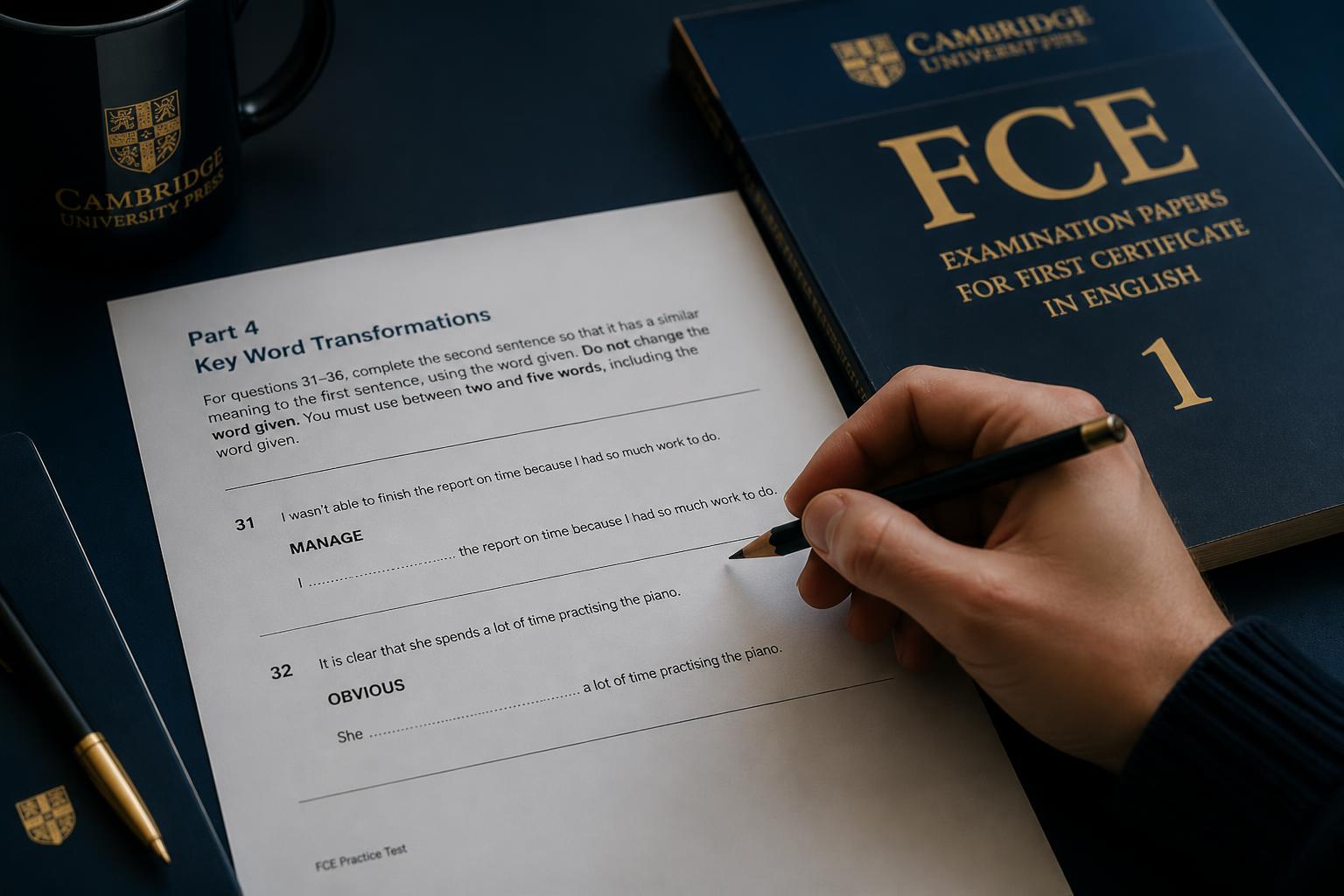
Use of English Part 4
Six sentences. Rewrite each one keeping the meaning, using 2–5 words, and the key word UNCHANGED. Highest-mark item per question on the paper.
Get talking · Section 1
5 minSay this aloud: 'I haven't seen him for years.' Now rephrase it starting with 'It's been…' (years since I saw him). Notice — same meaning, different grammar. That's Part 4.
In pairs, list 5 fixed English chunks (e.g. 'as soon as', 'put up with', 'in case of'). Why do exam writers love these?
Most candidates lose marks because they write too many or too few words. Why might the 2–5 word limit be the hardest part?
Grammar focus · Section 2
8–10 minThe eight patterns Part 4 keeps testing
Part 4 looks endlessly varied but recycles eight grammar patterns. Recognise the pattern and the answer almost writes itself..
- 1Passive voice — 'They built it' → 'It WAS BUILT'.
- 2Reported speech — 'I'll help' → 'He SAID he WOULD help'.
Examples
→ (1) PASSIVE: 'They built the bridge in 1995.' / BUILT → 'The bridge WAS BUILT in 1995.'
→ (2) REPORTED: 'I'll call you,' he said. / HE → 'He said HE WOULD CALL me.'
→ (3) CONDITIONALS: 'I don't have a car, so I can't drive.' / HAD → 'If I HAD A CAR, I could drive.'
→ (4) COMPARATIVES: 'No one is taller than Sam.' / TALLEST → 'Sam is THE TALLEST.'
→ (5) MODALS OF SPECULATION: 'I'm sure he's tired.' / MUST → 'He MUST BE tired.'
→ (6) PHRASAL VERBS: 'Please continue.' / CARRY → 'Please CARRY ON.'
→ (7) FIXED PHRASES / LINKERS: 'In spite of the rain…' / DESPITE → 'DESPITE THE RAIN…'
→ (8) DEPENDENT PREPOSITIONS: 'She's interested in art.' / KEEN → 'She's KEEN ON art.'
Question 1.'Someone has repaired my laptop.' / BEEN → 'My laptop ___ repaired.'
Question 2.'We last spoke in March.' / SINCE → 'We haven't spoken ___ March.'
Question 3.'No other film in the festival was so moving.' / MOST → 'It was ___ film in the festival.'
Question 4.'They postponed the meeting.' / PUT → 'They ___ the meeting.'
Question 5.'I'm certain she forgot.' / HAVE → 'She ___ forgotten.'
Quick check 1.How many WORDS go in each Part 4 gap?
Quick check 2.Can you change the KEY WORD given in capitals?
Quick check 3.Contractions ('don't') in Part 4 count as…
Vocabulary · Section 3
5–7 minWords & phrases to own
to transform
to change the form of something while keeping its meaning — exactly what Part 4 asks.
Say one true sentence about your own life using "to transform".
key word
the CAPITAL word that must appear in the answer, UNCHANGED.
Finish this out loud: "For me, key word is …" — then give one reason.
to keep the meaning
to preserve the original sense — the most common reason candidates lose marks.
Say one true sentence about your own life using "to keep the meaning".
passive voice
subject receives the action: 'The bridge WAS BUILT in 1995.'
Finish this out loud: "For me, passive voice is …" — then give one reason.
reported speech
saying what someone said: 'He SAID HE WOULD call.'
Finish this out loud: "For me, reported speech is …" — then give one reason.
phrasal verb
verb + particle that = new meaning: 'put off' = postpone.
Finish this out loud: "For me, phrasal verb is …" — then give one reason.
dependent preposition
a fixed preposition after a verb/adjective: 'keen ON', 'afraid OF', 'depend ON'.
Finish this out loud: "For me, dependent preposition is …" — then give one reason.
linker
a connector showing relationship between ideas: 'despite', 'because of', 'in spite of'.
Finish this out loud: "For me, linker is …" — then give one reason.
to paraphrase
to say the same thing in different words — Part 4 is paraphrasing under pattern rules.
Say one true sentence about your own life using "to paraphrase".
marker word
a small word that signals which pattern (e.g. 'since' → present perfect; 'if' → conditional).
Finish this out loud: "For me, marker word is …" — then give one reason.
Tap an item on the left, then tap its match on the right.
Pronunciation · Section 4
3–4 minSentence stress in transformations — the carrier of meaning
Say it aloud
- • Original: 'She '''rarely''' eats out.' — stress on 'rarely'.
- • Transformation: 'She '''hardly ever''' eats out.' — stress still on 'hardly ever'. Meaning preserved.
- • Original: 'I '''can't''' help noticing…' — stress on 'can't'.
- • Transformation: 'I can't '''help''' noticing…' — stress shifts → meaning bends. Re-check.
- • Drill: read both sentences aloud, side by side. If the meaning beats line up, you're right.
Reading · Section 5
8–10 minWhy Part 4 is really a pattern-recognition test
Read the passageTap to openTap to hide
Part 4 of the Use of English paper looks, at first glance, like grammar's revenge on the candidate. Six sentences must each be rewritten so that the meaning is preserved, the rewrite uses between two and five words, and a 'key word' supplied in capital letters appears in the answer without being changed. To the unprepared candidate this feels like a free-fall test of vocabulary and grammar at once. It is not. It is, in fact, the most pattern-based part of the entire paper.
The Cambridge writers do not invent fresh structures for each new exam. They recycle, with small variations, eight grammar patterns: the passive, reported speech, conditionals, comparatives and superlatives, modals of speculation, phrasal verbs, fixed linkers and dependent prepositions. A candidate who learns to recognise the key word as a SIGNAL — 'BEEN' triggers a passive; 'IF + HAD' triggers a second conditional; 'TOLD' or 'WHETHER' triggers reported speech — has already done two-thirds of the thinking before the pen moves.
The second insight is the word count. Two to five words is the strictest constraint in the paper, and it punishes two opposite mistakes. Candidates who write too few words usually miss a required auxiliary or article and lose the mark; candidates who write too many usually add a redundant adverb ('very', 'really') or convert a contraction back into two words without need. The professional move is to write the answer first, then count, then trim.
The third, and most often-ignored, insight is that the key word must appear UNCHANGED. 'BUILT' cannot become 'BUILDING'; 'SUCCESS' cannot become 'SUCCEED'; 'KEEN' cannot become 'KEENLY'. Every year a small share of marks is lost not on grammar but on the simple temptation to inflect a word that the rubric forbids. The rule is mechanical: copy the key word in capitals to scratch paper before writing the answer, and then build around it.
Drilled together — pattern, count, key word — these three habits raise Part 4 scores faster than any vocabulary list. The candidates who treat it as a guessing game lose marks every time. The candidates who treat it as pattern recognition, with three small mechanical checks, walk out having banked twelve marks they did not expect.
For questions 1–5, choose the answer (A, B, C or D) which you think fits best according to the text.
1According to the text, Part 4 is best described as a test of…
2How many grammar patterns do Cambridge writers recycle?
3What does the writer say is the strictest constraint?
4Why do candidates lose marks by writing TOO MANY words?
5What's the mechanical move to protect the key word?
Sentences have been removed from the text. Choose from the sentences A–E the one which fits each gap (1–4). There is one extra sentence which you do not need to use.
Exam conditions: keep “Read the passage” closed while you do this task.
Listening · Section 6
8–10 minA grammar tutor walks two students through three Part 4 items (≈ 2:00)
Listening audio
Tap play to listen. Drag the timeline to jump anywhere.
Show transcript
Tutor (Mr Adeyemi):Right. Item 25: 'They built the school in 1992.' Key word: BEEN.
Two to five words.
Lucia:I wrote 'The school was built in 1992.' But 'WAS' isn't the key word. I should be using 'BEEN'.
Tutor (Mr Adeyemi):Exactly. 'BEEN' signals present perfect passive. 'The school HAS BEEN STANDING since 1992' works — but watch the meaning.
Or, more naturally: 'The school HAS BEEN THERE since 1992.' Three words, key word preserved.
Marco:Item 26: ''I won't be late,' she promised.' Key word: WOULDN'T.
Tutor (Mr Adeyemi):Reported promise. 'She promised she WOULDN'T BE late.' Four words.
Key word in capitals, untouched.
Lucia:What if I'd written 'She promised that she would not be late'?
Tutor (Mr Adeyemi):Six words. Over the limit. The contraction WOULDN'T = one word, but 'would not' = two.
That's where careful candidates lose silly marks.
Marco:Item 27: 'I'm sure they're lost.' Key word: MUST.
Tutor (Mr Adeyemi):Modal of speculation, certainty. 'They MUST BE LOST.' Three words.
Don't try anything fancier — 'must be' carries the certainty exactly.
Lucia:So: spot the pattern, count the words, never touch the key word.
Tutor (Mr Adeyemi):Three mechanical checks. Do them on every item and you'll bank two more marks than you do now.
Question 1.Why did Lucia's first answer to Item 25 fail?
Question 2.Why was 'She promised that she would not be late' rejected?
Question 3.Does the contraction WOULDN'T count as one word or two?
Question 4.Tutor's three mechanical checks are…
Exam skills · Section 7
5 minUse of English Part 4 — Key Word Transformations
🎯 Part 4
6 items. Use 2–5 words. Key word UNCHANGED.
- Spot the pattern (passive, conditional, reported…)
- Build around the key word EXACTLY as given
- Count: 2, 3, 4 or 5 words. No more.
- Re-read both sentences — meaning must match
Open the Exam Practice block below.
Quick Tip
Copy the key word in capitals onto your scratch paper before writing — it stops you accidentally changing the form.
Exam Hack
Use contractions ('wouldn't', 'isn't') — they count as ONE word and save you precious slots.
Common Mistake
Don't paraphrase too freely — 'I'm sure he's tired' / MUST = 'He MUST BE TIRED', not 'He must feel tired'. Stay literal.
Your task
Complete each item in 2–5 words. The second sentence must mean the same as the first and contain the key word UNCHANGED. Then count, then re-check meaning.
Example
Q: 'It was such a boring film that I fell asleep.' / SO → 'The film was ___ I fell asleep.' Pattern → 'so + adjective + that'. Build: 'SO BORING THAT'. Count: 3 words. Meaning preserved. ✔
Practice · Section 8
8–10 minFill in the blank
Word bank — no clues, retrieve it
Question 1.Part 4 has ___ items.
Question 2.Each answer uses between ___ words.
Question 3.The key word must appear ___.
Question 4.'BEEN' usually signals a ___ structure.
Question 5.'IF + HAD' usually signals a ___ conditional.
Question 6.Contractions like WOULDN'T count as ___ word.
Q1.'They have built a new bridge.' / BEEN → 'A new bridge ___ built.' (2 words)
Q2.'I'm sure she's at home.' / MUST → 'She ___ at home.' (2 words)
Q3.'"I'll help you," he said.' / SAID → 'He ___ help me.' (3 words)
Writing · Section 9
5 minPut it in writing
Your task
Write your OWN Part 4 item. Choose a key word and write the original + second sentence with a 2–5 word gap. Swap with a partner and solve theirs.
Show model answer
ORIGINAL: 'They postponed the meeting because of the snow.' KEY WORD: OFF SECOND SENTENCE: 'The meeting ___ because of the snow.' ANSWER: 'WAS PUT OFF' (3 words) — passive of the phrasal verb 'put off' = postpone. Meaning preserved, key word in capitals, within the 2–5 range.
Speaking · Section 10
10–15 minMake it a real conversation
Roleplay
Pair drill. A says: 'pattern + key word' (e.g. 'second conditional, HAD'). B says a complete transformation example in under 10 seconds. Swap. Cover all eight patterns.
Useful phrases
- • The key word here is… so the pattern must be…
- • I'd start the gap with…
- • Counting: that's three words.
- • If I change BUILT to BUILDING I'll lose the mark.
- • Meaning still matches the original.
- • Contraction saves me one word.
Teacher notes
Optional · Teacher-led
Teacher Activities
Two compact extensions that train pattern-recognition reflexes — both work 1:1 online. ~18 min total
FCE Exam Practice · Section 11
20–30 minReal FCE tasks
Cambridge B2 First · Reading & Use of English · Part 4. Six items. 2–5 words. Key word UNCHANGED. Teacher Mode reveals answers and per-item rationale.
For questions 1–6, complete the second sentence so that it has a similar meaning to the first sentence, using the word given. Do not change the word given. Use between two and five words.
1.They are repairing the road outside our house.
BEINGThe road outside our house at the moment.
2.'You took my umbrella,' Sara said to me.
ACCUSEDSara her umbrella.
3.If you don't hurry up, you'll miss the train.
UNLESSYou'll miss the train up.
4.I'm sure he didn't see us.
CAN'THe us.
5.I find it impossible to work with so much noise around.
PUTI can't with so much noise around.
6.She started learning Italian five years ago.
BEENShe Italian for five years.
Homework · Section 12
Take-homeTake it home
Six-item Part 4 set
Complete six FCE-style transformations in 12 minutes.
Each gap must be 2–5 words, include the KEY WORD UNCHANGED, and preserve the meaning. Count your words before submitting each item.
- 'I haven't visited my grandmother for three years.' / SINCE → 'It's been three years ___ my grandmother.'
- 'They cancelled the concert because of the storm.' / CALLED → 'The concert ___ because of the storm.'
- ''I'll see you tomorrow,' Tom said to me.' / WOULD → 'Tom told me ___ the next day.'
- 'I'm sure she didn't take the keys.' / CAN'T → 'She ___ the keys.'
- 'The film was so boring that we left.' / SUCH → 'It was ___ that we left.'
- 'In spite of the rain, we went out.' / DESPITE → '___ raining, we went out.'
Key-word pattern radar
Match ten key words to their most likely grammar pattern.
For each key word, write the pattern it most often signals in Part 4 (one of: passive / reported / conditional / comparative / modal speculation / phrasal verb / linker / dependent preposition).
- BEEN
- WOULDN'T
- IF
- MUST
- PUT
- DESPITE
- KEEN
- TOLD
- AS
- UNLESS
Mini Part 4 paper
Invent two of your own Part 4 items and swap with a classmate.
Pick TWO of the eight patterns. Write the original sentence + key word + second sentence with a 2–5 word gap. Provide the answer on a separate line marked TEACHER ONLY.
Recap · Section 13
2–3 minWhat you've learned
- Part 4 = 6 items, 2–5 words each, key word in CAPITALS UNCHANGED.
- Eight patterns recycle: passive, reported, conditionals, comparatives, modals of speculation, phrasal verbs, linkers, dependent prepositions.
- Key word is a SIGNAL — name the pattern before writing.
- Word count is the strictest rule on the paper. Count BEFORE submitting.
- Contractions count as ONE word — use them to stay within the limit.
- Three mechanical checks every time: pattern · count · key-word unchanged.
Lesson progress
This lesson completes automatically once you finish every activity, or when you continue to the next lesson.